Since automotive restoration is a high-stakes game, you can only achieve as much as you can see. When you are working in a studio in India, you are already realizing that it is not easy to fix the paint because of the humidity change and the harsh tropical sun. There is a difference between making your lighting bright and making it scientific, and installing professional detailing lights for garage use is the first step towards achieving a truly showroom finish.
However, to most studio owners, the question of switching from basic bulbs to a professional setup elicits one significant question: What is the real cost of a professional installation in India?
In this blog, we subdivide the investment into generic categories to help you budget for a world-class workspace.
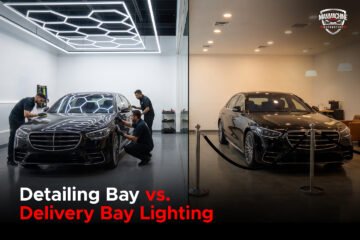
Why Does Commercial Garage Lighting Displease Professional Detailers?
The Issue: Most Indian workshops use standard industrial tube lights or domestic LEDs. These are designed for general visibility rather than optical examination. They produce flat light that covers swirl marks, holograms, and high points in the coating.
The Agitation: Visualize having spent 12 hours on a multi-stage paint correction, only for the client to drive out into the sun and realize there are micro-scratches you failed to notice. This not only damages your reputation but also results in costly re-work and loss of customer confidence.
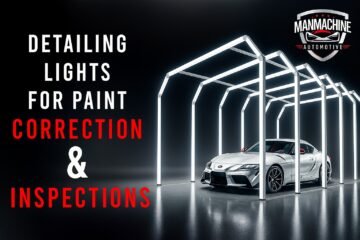
The Solution: A high-CRI (Color Rendering Index) and modular system. By using specialized car detailing lights, ceiling grids, and vertical panels, you get a “controlled sun” environment in which even the smallest flaws are visible prior to the car leaving your bay.
How Do Different Lighting Types Compare?
Before plunging into costs, you should know what you are paying for. Not all auto detailing lights are created equal.
| Lighting Type | Best For | Visual Impact |
| Hexagon Grids | Main Bay Ceiling | High (Showroom Look) |
| Linear Wall Lights | Side Panels/Doors | Essential for Correction |
| Inspection Lamps | Spot Checking | Critical for Quality Control |
What are the Major Investment Levels in Equipment?
The cost of detailing studio lights is mostly classified into three professional types, depending on your business objectives:
| Investment Tier | Typical Setup | Ideal For |
| Startup Tier | Basic LED Tube Arrays | New/Small Garages |
| Professional Tier | Aluminum Hexagon Grids | Established Studios |
| Elite Tier | Full Tunnel & High-CRI Grids | Premium PPF Centers |
Stop Working in the Shadows
Each swirl that you fail to see is a mark against your image. Professional lights for detailing are not a cost; they are an investment that pays back with higher efficiency and greater sales.
Explore Our Professional Detailing Lights Collection: Range of Detailing Lights
What are the Generic Cost Factors of a Single Bay?
Although numbers differ depending on the brand and material, a professional bay setup in India requires these four pillars of investment:
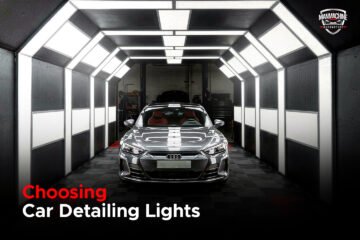
- The Main Ceiling Grid: Your studio star. High-quality aluminum profiles, such as those offered by Manmachine Automotive, cost more than plastic alternatives but are required to dissipate heat in the Indian climate.
- Vertical and Side-Wall Lighting: This is necessary for detecting defects in the bottom half of the car. This includes a moderate repetitive cost per bay for about 4-6 panels.
- Infrastructure & Fabrication: This includes custom metal frame mounting, high-quality copper wiring, and surge-insulated MCBs to cope with power fluctuations.
- Specialized Labor: Grid installation is more complicated than home installation. The 12-hour to 2-day installation fee is based on the professional advancement of a grid that must be perfectly leveled and grounded.
Is Studio Location a Factor?
Yes, regional considerations in India influence your final bill:
| Region | Labor Cost | Material Factor |
| Tier-1 Metros | Higher | Easier Availability |
| Tier-2/3 Cities | Lower | Potential Shipping Costs |
| Coastal Cities | Moderate | Moisture-Resistance Required |
The Importance of Lux and CRI
In professional detailing, it is not enough to be bright but rather precise. Standard light of 150-300 lux suffices to complete the general tasks, such as washing. But in the case of fine work, such as painting and applying ceramic coating, it requires an environment of 750-1000 lux, and some of the higher-end studios even go to 1500 plus lux in color matching.
Moreover, the quality control standard that cannot be compromised is the Color Rendering Index (CRI). Whereas conventional bulbs usually have a CRI of less than 80, detailing lights for garage are aimed at achieving a CRI of 90 or even 95 or more. This guarantees that the colors that you see are correct and that the actual state of the paint is known, and you are not going through those irritating times when a so-called black car turns out to have a foggy blue color only when it reaches the driveway.
Thermal Management in Plastic Vs. Aluminum Housing
The climate in India is also a challenge, that is, the heat. The lifespan of an LED may decrease by up to 40 percent with each 10°C increase in the internal junction temperature. It is the reason that what you have in your detailing lights for garage is no less important than the chips that are in them.
Aluminum Housing: When the housing is made of aluminum, it serves as a high-performance heat sink. It proactively removes heat in the LED chips, keeping the brightness steady and eliminating the tendency of many older systems to yellow.
Plastic Housing: Plastic is not a good thermal conductor and is frequently used in low-cost constructions. The heat may eventually crack the housing or cause the LEDs to fade out when it becomes too hot, and thus much more expensive to replace in the long run.
Content Creation Flicker-Free Technology
In the age of the digital era, your studio is your film set as well. Common LEDs contain a flicker that cannot be seen with the naked eye, but which leaves ugly black lines or “strobing” in smartphone videos and slow-motion reels.
Flicker-Free Drivers (High-Frequency PWM) are used to provide high-quality lights to make the details. The technology guarantees a continuous flow of light, which appears flawless on camera, thus you are able to take those desirable before and after changes that are critical to your marketing with social media.
It is possible to eliminate the so-called Shadow Gap using the 45-Degree Rule.
Another error that is common in most Indian studio layouts is that all the lights are mounted back-to-back. Although this illuminates the garage, it casts ugly shadows along the lines of the fenders, bumpers, and side skirts. Due to the fact that the car itself blocks the light from reaching the bottom panels, road grime and rock chips are usually not noticed.
Cross-lighting is necessary in order to attain really shadowless illumination by professional installers. This includes the placement of side-wall linear panels in such a way that the light has a 45-degree angle in the work bay. This wrap-around effect fills the shadows presented by the body lines of the car, and you never miss the high spots when applying a ceramic coating or silver-paint imperfections that are only visible when you apply it at certain angles.
Conclusion
It converts a rudimentary garage into an elaborate studio. While the first arrangement needs an initial investment, it is usually paid back in the first few ceramic coating or PPF jobs by the degree of professionalism it exudes. So, are you ready to light up your success? Poor lighting should not be the weak point of your business. Whether it is a new studio or an upgrade, we have the solutions needed to illuminate your profession. So contact Manmachine Automotive now +91-9310000-356.
FAQs
Q1. Will I be able to save cash using DIY installation?
It is possible, but professional installation is safer. A pro makes the grid absolutely parallel to provide equal reflections and ensures adequate MCB protection to avoid voltage variations.
Q2. What benefits does 6500K “Daylight” have?
This is the color with the best contrast. It “pops” micro-scratches and holograms on the paint, which is required in professional paint correction.
Q3. How do I maintain my LED grid?
Polish dust can dull brightness by 30%. Wipe the fixtures monthly using a dry microfiber cloth. Never spray liquids directly on the lights to prevent short-circuiting.
Q4. Why use Aluminum instead of Plastic housing?
India’s heat is an LED killer. Aluminum housing acts as a heat sink to ensure the lights do not dim or yellow over time, unlike cheaper plastic alternatives.
Q5. Are Hexagon lights just for appearance?
No. While they look great on social media, the honeycomb design offers multi-directional/shadowless light. This guarantees you see every inch of the car during coating or PPF installation.
Q6. Are detailing lights for garage consuming much electricity?
Actually, no. Since they operate on high-efficiency LED technology, a complete detailing lights for garage installation in a garage may require less power than two obsolete halogen work lights and give 5 times the useful output.
0 Comments