Right lighting for your car detailing studio is vital for flawless paint correction, accurate inspection, and a professional finish. Your car detailing lighting setup should make you notice each swirl, scratch, and imperfection. Modern studios rely on LED lighting for car detailing to advanced detailing bay lights.
Car detailing light setup price is around ₹15,000 to ₹70,000 (Approx.). Lighting for car detailing cost is not rigid but varies depending on your studio bay and matrix arrays. Many giants in this arena have stepped up their car detailing light setup. They improve visibility, reduce eye strain, and enhance precision when working in long correction sessions.
If you are browsing the best lighting for car detailing or car detailing studio lights and installation costs, your first step should be a thorough understanding. If you strive for clarity, safety, and performance, read our guide to master the best lighting options for your car detailing studio. We will explore auto detailing studio lighting layouts, compare car detailing light setup price and lighting installation for car detailing cost. These together will help you design a professional detailing studio light design. Packed with the information, you will be able to find lighting for car detailing near me.
Lighting is the best option for those who are planning to give their garage a makeover. Read our blog on garage remodel mistakes.
Car Detailing Lighting: Why It Is the Most Underrated Tool in Detailing
Most detailers obsess over polishes, pads, and paint protection film. But what if you can’t see what you’re working on? Here comes the car detailing studio lights. A poor detailing lighting can make you ignore:
- Paint defects
- Swirl marks
- Micro-scratches
- Water spots
- Holograms
Professional-grade detailing studio Light design is engineered to reveal what the naked eye misses. A standard garage bulb or fluorescent shop light can not replace LED lighting for car detailing.
Best lighting for car detailing:
- Reveals paint defects during paint correction
- Your client’s car gets a uniform polish application
- You can identify missed spots after ceramic coating
- Prevents over-buffing by showing real-time surface changes
- Consistent results across every panel
Answer this question: Can you do precise detailing work in the dark? literally or figuratively? No. That’s why lighting for your car detailing studio is critical.
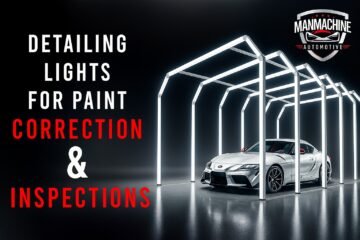
Related Reads: Best detailing lighting for paint correction and inspection
Car Detailing Lights: Types of Lighting
Understanding the types of car detailing lights available will help you build a setup that suits your workflow. Best lighting options for your car detailing studio are given below:
1. LED Shop Lights (Overhead Panel Lights)
LED panel lights are the backbone of any professional car studio lighting setup. They are mounted overhead. They provide wide and even coverage that reduces harsh shadows. Look for high-lumen output (at least 5,000-10,000 lumens per fixture) and a Color Rendering Index (CRI) of 90 or above. The higher the CRI, the more accurately colors are rendered. This is important when you match paint or assess finish quality.
2. Handheld Inspection Lights
These are your close-up weapons. A handheld detailing light lets you angle the beam across paint surfaces. You can spot swirl marks, haze, and scratches through raking light. The beam hits the surface at a low angle which makes the defects pop.
Look for dual-light options:
- One should be bright white
- Second, that’s more focused
With this, you can switch between inspection modes quickly in car detailing studio lights.
3. Flood Lights and Work Lights
Flood lights are excellent for illuminating entire vehicle sides at once. If you position them right, they simulate natural outdoor light. It helps you to identify panel-level imperfections like orange peel texture or compound haze.
4. UV/Black Lights
They are not the conventional type of studio lights for car detailing. While not for general detailing, UV lights serve a specific purpose. They detect contamination, ceramic coating coverage, and adhesive residue. Professional detailers can keep one handy to verify that coatings are applied evenly.
Color Temperature: The Number That Changes Everything
Color temperature is essential in choosing a lighting setup for your car detailing studio. It is measured in Kelvin (K).
| Color Temperature | Light Appearance | Best Use |
| 2700K-3000K | Warm white/yellow | Not ideal for detailing |
| 4000K-4500K | Neutral white | Good for general inspection |
| 5000K-6500K | Cool/daylight white | Best for paint correction & defect detection |
Car Detailing Lighting: Ideal Color Temperature
5000K–6500K is the sweet spot for auto detailing lights. This range is similar to natural daylight. It is the most revealing for surface defects. If the car detailing studio lights are below 4000K, they introduce a warm cast and it can further mask paint imperfections.
Read in detail: Why color temperature in detailing lights can make or break your detailing game
Car Studio Lighting Setup: How to Build One
A professional car studio lighting setup doesn’t have to cost a fortune. Lighting for car detailing cost depends on a number of factors. For a car detailing light setup price, you must consider the planning. Here’s how to structure it:
Step 1: Overhead Lighting First
Start with four to six high-CRI LED panel lights or strip lights mounted to the ceiling in a grid pattern.
- This eliminates dark zones.
- Provides a consistent baseline of illumination.
- Aim for full coverage of the working area with no dead spots.
- Space the panels evenly. No panel should be more than 6-8 feet from the vehicle surface.
- Taller ceilings need more lumens so that they can compensate for light s
Step 2: Add Side-Wall Lighting
If you mount LED lights along the walls at door-panel height, it creates a secondary light source.
It skims across the vehicle’s sides.
This side-lighting technique is effective for swirl marks and buffer trails on doors, fenders, and quarter panels.
Step 3: Portable Inspection Lights
A high quality handheld inspection light is important if you are performing panel-by-panel work. A overhead and side car studio lighting setup can not make up for it. This portable light is non-negotiable for paint correction stages. You can get more precise check with a focused beam than flood lights.
Step 4: Control Glare
Car detailing studio lights should not be too much either. It is as problematic as too little. Use diffusers on harsh LEDs in car detailing lighting. You should avoid pointing lights directly toward eye level. Anti-glare LED panels deserve a place in your car detailing light setup.
How to Choose Auto Detailing Lights
Before buying, evaluate car detailing studio lights:
CRI (Color Rendering Index): Go for CRI 90+. CRI 95+ is ideal for lighting in professional studios.
Lumens: More lumens means more light. For a standard two-car garage, you need a combined output of 30,000-50,000 lumens.
Color Temperature: 5000K-6500K is needed for maximum defect visibility.
Beam Angle: Wider beam angles (120°+) for overhead lighting. Narrow, focused beams are best for handheld inspection lights.
Heat Output: LED lighting for car detailing runs cool compared to halogens. It is important during long detail sessions.
Portability: You can invest in rechargeable, battery-powered inspection lights.
Durability: If your workspace gets dusty or humid, look for IP-rated fixtures.
Car Detailing Lighting: Common Lighting Mistakes Detailers Make
If you are to choose a lighting setup for your car detailing studio, do not fall prey to these confusions:
You Use single-source lighting:
One overhead light creates harsh shadows. It misses entire sections of the vehicle. Always use multi-point lighting.
Ignoring color temperature:
Working under warm-white bulbs feels comfortable but hides defects. Switch to daylight-spectrum LEDs.
You skip handheld lights:
Overhead lighting alone is insufficient for paint correction. A handheld inspection light is essential, not optional.
Placing lights too high:
The further the light source, the more diffuse and less revealing it becomes. Lower placement makes the defect visible.
You do not adjust different panels:
Hoods, roofs, and horizontal surfaces require different light angles than doors and quarter panels.
Also Check: The difference between detailing lights and garage lights
Why Manmachine Automotive Stands Out for Detailing Lighting
When it comes to high-performance car detailing lights, Manmachine Automotive has established itself as a trusted name.
Ultraguard’s detailing lighting solutions are purpose-built for the automotive environment. Our lights deliver 95+ CRI output at a true 5500K-6000K daylight spectrum. With Ultraguard, you see every defect exactly as it appears in natural outdoor light.
What Sets Manmachine Automotive Apart in Car Detailing Lighting
- Ultra-high CRI: Consistent 95+ CRI across all lighting products for true-to-life color accuracy
- Optimized color temperature: Engineered at the 5500K-6000K range proven most effective for defect detection
- Glare-controlled diffusion: Anti-glare diffuser panels reduce eye strain during long sessions
- Robust build quality: Designed for workshop environments. Dust-resistant, moisture-tolerant, and built to last
- Versatile range: From overhead panel systems ideal for a car studio lighting setup to compact handheld inspection lights for mobile detailers
Manmachine Automotive doesn’t just sell lights. We offer a complete car detailing studio lights for the detailing ecosystem that works together.
Conclusion
Great detailing starts with great visibility. Poor lighting for your car detailing studio can not support the best detailing for your car. Understanding light types, color temperature, CRI, and placement gives you the foundation to build a workspace. The best lighting for car detailing gives consistent results. Start with overhead daylight-spectrum LEDs, add side-wall lights, and always keep a quality handheld inspection light within reach.
In this journey, Manmachine Automotive can remove the guesswork and make the product selection customised. We deliver a car detailing light setup designed specifically for the demands of auto detailing.
At Manmachine Automotive, we believe that if you see more, you detail better.
Frequently Asked Questions
Q. What is the best color temperature for car detailing lights?
Ans. 5000K-6500K (daylight spectrum) is best. It shows you paint defects most accurately. It also mimics natural outdoor sunlight.
Q. How many lumens do I need for a detailing garage?
Ans. You need 30,000-50,000 total lumens. It is good to go for a standard two-car garage. This will be enough to eliminate shadows and dark zones.
Q. What does CRI mean for detailing lights?
Ans. CRI (Color Rendering Index) measures color accuracy. Always choose CRI 90 or higher for detailing studio lights. 95+ is professional standard.
Q. Can I use regular LED shop lights for car detailing?
Ans. You can. But standard shop lights lack sufficient CRI and proper color temperature. You can miss paint defects.
Q. Do I need a handheld light if I have overhead lights?
Ans. Yes. Overhead lights can’t replicate the low-angle raking effect of a handheld light. A handheld is essential for spotting swirl marks.
Q. What is a car studio lighting setup?
Ans. It’s a multi-point lighting arrangement that uses overhead panels, side-wall lights, and portable inspection lights. It is your hub for complete defect visibility.
Q. Are UV lights useful for car detailing?
Ans. Yes. UV lights for car detailing are useful. Specific tasks like verifying ceramic coating coverage, adhesive residue detect, and identifying contamination on paint. They are better done in UV lights.
Q. How often should detailing lights be replaced?
Ans. Quality LED detailing lights last 50,000+ hours. You should replace them when brightness or color accuracy degrades.
Q. Is Manmachine Automotive suitable for mobile detailers?
Ans. Yes. Manmachine Automotive offers portable, rechargeable lighting options. These are designed for mobile professionals who work without fixed power sources.
Q. Why do swirl marks disappear under some lights?
Ans. Warm or low-CRI lighting hides surface texture. Manmachine Automotive daylight-spectrum, high-CRI lights reveal defects other lights hide.
0 Comments