Poor garage lighting is a big no for car detailing professionals and even car owners. It is one of the most overlooked aspects in garage makeovers. LED strips from a hardware store are not enough. You might think of it as a cheap option, but think critically. Poor garage lighting costs more in the long run. How? Energy use, replacement frequency, and labor costs shoot up when you install the low-quality garage lights. Not to mention, the risk of accidents and damage rises too.
Better garage lighting will cost you more upfront, but it will reduce operational costs. Let’s understand it via an example. Ravi thinks that a cheap fixture is a smart save for his parking lot lighting. He thinks a light is a light, so why spend more? Two years later, it failed. Then came the replacement cost. Then labor, Then another installation.
A few years after that? Same story again.
Meanwhile, his neighbor installed something that still works fine.
That’s when Ravi realized…cheap options are actually anything but cheaper. They just sent the bill later.
So let us tell you why you should look for bright, energy-efficient LEDs, good coverage, and fixtures with a reliable lifespan and warranty support. Manmachine Automotive gives you a range of products that aren’t just lower upfront price, but have lower total cost over the fixture’s life.
Poor Parking Lot Lighting: How It Affects You
Walk into most Indian garages or detailing studios. You will find tube lights or basic LED battens installed along the ceiling. They flood the space with general light. Brightness and quality of light are two completely different things.
When you work under flat, low-CRI lighting, your eyes compensate. You think the paint correction is complete…the ceramic coating is clean. Then the car rolls out into daylight and the client calls you back within the hour. That rework costs you time, materials, and consumables. And the worst part is a reputation hit that no marketing budget can fix overnight.
One missed swirl mark or hologram under bad garage lighting is not just a cosmetic issue. It is a business cost. In professional detailing, the light you work under directly determines the quality of the finish you deliver. This is not a preference. It is a technical requirement.
Read our related guides on garage lighting:
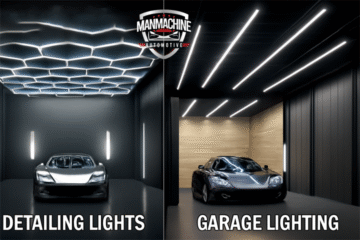
- Difference between garage lighting and detailing lights
- Colour temperature in detailing lighting
- Best detailing lights for paint correction and inspection
Bad Garage Lighting: What It Actually Costs You
Older HID fixtures cost around ₹8,700-₹12,600 per lamp in electricity on a yearly basis. If you maintain a single wall-pack fixture for three years, it can climb to ₹4.3 lakh approx. One NYC survey reports that there is almost 40% less crime in well-lit complexes. Moreover, poor garage lighting weakens camera visibility and evidence quality.
Bad garage lights also create costs that you might not think about.
Safety Incidents
Curbs, potholes, pedestrians, or moving vehicles are hard to see in dark parking lots. Collisions and slip-and-fall injuries are frequent in these kinds of spaces.
Security Losses
Poor visibility invites theft, vandalism, and break-ins. Your CCTV footage will also be blurry.
Legal Liability
Owners can face lawsuits, settlements, and compliance issues if any incident happens in their spaces.
Higher Operating Costs
Outdated lighting systems use more electricity. Maintenance will be more frequent.
Lost Revenue
Poor garage lighting communicates directly to a customer’s perception. This negligence can be negative for retention.
Garage Lighting Explained: What It Means
The two specifications that matter most in any garage lighting setup are:
- Lux level
- Color Rendering Index (CRI)
What is Lux in Garage Lighting
- Lux measures how much light a surface gets.
- 200 to 300 lux: Washing or storage takes.
- 750 to 1000 lux: For paint correction, coating application, and defect inspection.
- 1500 lux or above: High-end studios working with luxury cars and premium ceramic coatings
What is CRI in Garage Lights
How accurately a light source renders colors compared to natural daylight? We have CRI to measure it. A CRI of 100 is perfect daylight.
- CRI 70 to 75: Standard industrial tube lights. Colors you see under them are distorted from reality.
- CRI 90 and above: Professional detailing lights for garage setups.
- CRI 95: In this CRI, you can tell the difference between a black car and a car with a deep blue metallic finish.
Garage Lighting CRI and Brightness Comparison
| Lighting Type | Typical CRI | Lux Output |
| Basic Tube Lights | 65-75 | 150-250 |
| Standard LEDs | 75-83 | 200-400 |
| Professional Detailing Lights | 90-97 | 800-1500+ |
Is Color Temperature Important in Garage Lighting?
Yes. The color temperature matters in garage lights.
- A 6500K daylight rating is the standard for professional detailing environments.
- This temperature creates the contrast needed to identify micro-scratches, swirl marks, and coating high spots.
Garage Lighting Shadow Problems
Here is something that most people running garages do not know. You can have bright lights and still have terrible garage lighting. Why? Because your layout is wrong.
Why Most Garage Lighting Layouts Fail
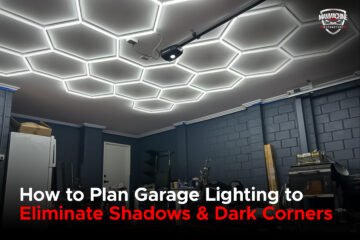
What’s the most common mistake in Indian studios? Mounting all the lights in a straight row on the ceiling. This creates a pool of light in the middle of the car. Lower panels, door sills, bumpers, and wheel arches get partial shadow. Rock chips, scratches, and coating misses accumulate in this part of your vehicle.
The Professional Cross-Lighting Setup
Professional setups use a cross-lighting principle. Side wall panels are installed at a 45-degree angle to the work bay. The car’s own body lines create shadows. This wrap-around effect fills those shadows. If you opt for professional lighting, you can inspect every inch of the vehicle. No more moving the car or relying on a hand-held torch.
Flicker-Free Garage Lighting for Better Studio Content
This is a cost that most studio owners only discover after it is already hurting them.
How Poor Garage Lighting Ruins Video Content
Most standard LED lights operate on pulse-width modulation. It creates a flicker that the human eye does not register. But a camera sensor captures it clearly. In the result, you see dark horizontal bands or a strobing effect in before-and-after videos and car reveal content.
Better Garage Lighting Means Better Social Media Results
If you are running a studio in today’s market, your social media content is one of your most powerful marketing tools. Flicker-free, high-frequency driver technology gives you clean and professional shoot. You get:
- More enquiries
- Higher perceived quality
- Better conversion
Manmachine Automotive for Garage Lighting: Why Choose Us
We, at Manmachine Automotive, have been in the market for over 38 years. Our detailing lights are built specifically for the Indian environment, which means they are tested against:
- Teat conditions
- Humidity levels
- Power fluctuation patterns that are common across Indian studios and workshops
Professional Garage Lighting Lasts Longer
Our product range includes hexagon ceiling grids with aluminum housing. It serves as a proper heat sink in a country where ambient temperatures regularly exceed 40 degrees Celsius.
Built for Indian Garage Conditions
Plastic housing alternatives lose brightness and start yellowing within two years in these conditions. The aluminum builds from Manmachine Automotive are designed to hold their CRI and lux output across the long term.
Garage Lighting for Content and Detailing Accuracy
For studios focused on content creation, the flicker-free driver technology in the Manmachine Automotive lighting range means your reels and reveal videos come out clean without any post-production fixes. For studios focused on technical output, the high CRI ratings mean that what you see in your bay is exactly what your client sees in daylight.
Our Professional Garage Lighting Options
We offer a multitude of garage and parking lot lighting options.
| Light Model | Best For | Brightness Output |
| SkyPanel Light | Delivery bays
Final inspection |
2140-2640 LM/W |
| PanelRay X Lights | Paint correction
Polishing |
2140-2640 LM/W |
| FlowShield Light | Coating
Detailing inspection |
2100-2310 LM/W |
| SpectraX Hexa | Studio detailing
Polishing |
23200-32760 LM/W |
| SpectraWash Shield | Wash bays
Foam application |
23200-25200 LM/W |
| ProDetail Light | Precision detailing work | 2100-2310 LM/W |
Ready to Upgrade Your Garage Lighting?
Discuss the right garage lighting setup for your studio
Contact Manmachine Automotive at +91-9310000-356
Conclusion
Garage lighting is not about looks. It actually affects:
- how well you work
- how efficient your team is
- how much your clients trust you and
- how good your content is
Bad lighting causes you to redo work. The right lighting setup in your garage pays for itself. A good setup has high-quality lights to cover the whole area. This is not a luxury for car detailing studios; it’s a must-have for any serious operation.
If your garage still has lighting tubes or regular LEDs, you’re probably losing money. The question is, what’s the solution?
Upgrade your workspace with Manmachine Automotive for professional garage lighting designed for detailing precision, better visibility, and longevity.
Frequently Asked Questions
Q1. What is the minimum CRI recommended for a professional detailing studio?
Ans: A CRI of 90 is the professional minimum. For premium work like PPF and multi-stage paint correction. You can go for CRI 95 or above for accurate color and defect visibility.
Q2. How many lux does a detailing bay need?
Ans: A working detailing bay needs between 750 and 1000 lux. This is for standard correction work. High-end studios that do color-matching and ceramic coating inspection operate at 1500 lux or more.
Q3. Why does flicker-free lighting matter for a garage?
Ans: Flicker creates strobing in video content shot inside your studio. Flicker-free drivers ensure clean before-and-after reels and car reveal videos that perform better on social media.
Q4. Is aluminum housing worth the extra cost over plastic?
Ans: Yes. In Indian temperatures above 40 degrees Celsius, plastic housing traps heat and causes LEDs to yellow and lose output within two years. Aluminum dissipates heat and holds brightness longer.
Q5. Can I install professional detailing lights in a home garage?
Ans: Yes. Manmachine Automotive offers garage solutions for single-bay home garages. Our products span multi-bay commercial studios. You can customize the layout and lux output as per your needs.
Q6. What color temperature is best for detailing garage lights?
Ans: 6500K daylight is the standard for a garage light. It creates the contrast for:
- Identify swirl marks
- Holograms
- Coating high spots
Warmer temperatures mask these details.
0 Comments